
Advisorator Free: Better sleep with smart earplugs

Sleep-centric earbuds compared

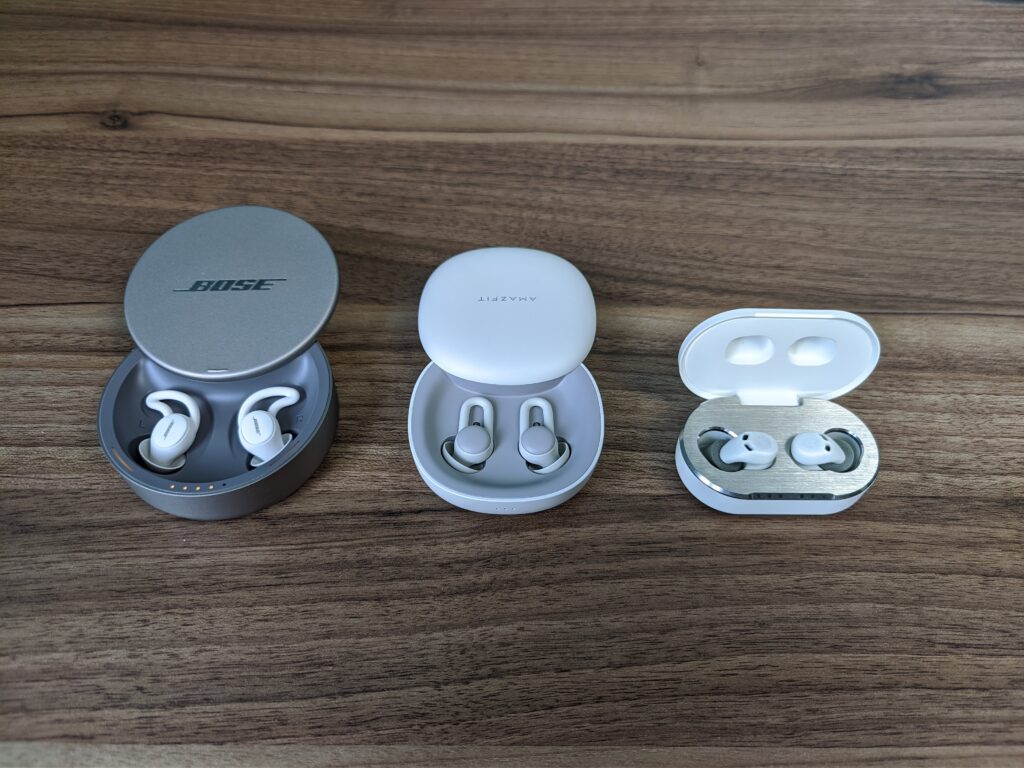
Hey folks, I’m unlocking this week’s feature topic from the full edition of Advisorator. Sign up to get advice like this in your inbox every Tuesday.
For reasons I haven’t quite grasped, my body’s become convinced that I’m an early riser. Almost every morning, I start stirring about two hours before I’m supposed to, and from then on it’s a struggle to relax myself back to sleep.
So when a company called QuietOn reached out a couple months ago about loaning a pair of its active noise cancelling earplugs to review, I was intrigued. Distracting sounds are part of what keep me up, and while I’ve tried using cheap Bluetooth earbuds to pipe white noise into my ears, they’re too big to wear comfortably without lying on my back. QuietOn’s buds are much smaller and entirely focused on silencing outside sounds.
It turns out this isn’t a unique concept, but rather one entry in a budding category I’ll describe as “smart earplugs.” Compared to regular Bluetooth earbuds, these devices have limited features—they can’t, for instance, take calls or play music from your phone—but they’re small enough to keep side sleepers from crushing their ears.
After getting a pair of QuietOn 3 earbuds to review, I decided to try a couple others to see how they compare. While they each have their strengths and weaknesses, they’ve all been helping me get better sleep when my body clock won’t cooperate.
QuietOn 3: Anti-snoring simplicity

The most interesting thing about the $200 QuietOn 3 buds is that they don’t connect to your phone at all. Just open the case and pop the buds in your ears, and the on-board microphones automatically start cancelling noise.
The buds’ foam ear tips come in four sizes, and do a decent job blocking higher pitched sounds—birds chirping, kids yelling—but the active noise cancellation helps with lower-frequency sounds that ear plugs alone can’t eliminate. Publicly, I can neither confirm nor deny that my wife snores, but hypothetically if someone happened to be snoring right next to you, the earbuds would mask enough of the sound to not be bothered by it.
Still, I had a couple of gripes that made made me want to investigate other solutions. QuietOn’s earbuds started to feel uncomfortable to me after a couple of hours, partly because of the hard plastic behind the eartips, and partly because my ears are sensitive to active noise canceling in general. (If you’re someone who experiences the “eardrum suck” effect in noise canceling headphones, it’s present here as well.) And while simplicity is part of the appeal with QuietOn’s earbuds, the lack of any ambient noise options resulted in more silence than I prefer.
Bose Sleepbuds II: More useful, less noise canceling

Looking for smart earplugs with ambient noise options led me to Bose’s $249 Sleepbuds II, which take a much different approach to solving sleep problems.
They don’t offer active noise cancellation, and the floppy silicone eartips, which come in three sizes, don’t plug your ears as tightly as QuietOn’s foam tips. But because they pair with an app on your phone, they can pipe in ambient noise, nature sounds, or soothing tones to cover up outside sound. They also have an alarm function to wake you up without disturbing your partner.
While you can’t connect the Sleepbuds to any other apps, I was mostly happy with Bose’s built-in sound selection. Digging the app’s settings menu also revealed some helpful features, such as a sleep timer and a “phone-free mode,” which lets the buds play a preferred sound right when you remove them from the case. I only wish you could mix multiple sounds together at the same time.
Best of all, Bose’s buds were comfortable enough to leave in my ears for hours, even while sleeping on my side. You’ll still notice them, of course, but the soft silicone enclosure and wingtips give the buds some much-needed cushioning when your ear’s against the pillow.
Amazfit Zenbuds: A cheaper alternative

Amazfit’s Zenbuds are clearly an attempt to undercut Bose’s Sleepbuds. The silicone eartips have a similar design with wingtips on the end, and they pair with a mobile app for ambient sounds and alarms. Amazfit also tries to go further on features by optionally monitoring your heartrate and sleep positions throughout the night. At $150, they’re the cheapest smart earplugs I tested, and they were even cheaper when I grabbed them for $92 on Prime Day.
Unfortunately, the lower price also comes with some noticeable trade-offs. The silicone feels a bit firmer and less comfy than Bose’s buds, and the selection of sleep sounds is much more limited. Amazfits’ Zepp app also pulls double-duty as as health tracking app for other Amazfit products, which means it’s cluttered with features that get in the way of the Zenbuds’ sleep functions.
Worst of all, the Zenbuds’ silicone tips blocked out less noise than the other two pars of earbuds I tested. That means you really have to crank up the buds’ ambient audio levels if you’re trying to mask snores or other distractions.
The verdict
I realize that I’ve only scratched the surface of high-tech sleep aides—I’ve yet to experiment with Bluetooth sleep masks, anti-snoring pillow inserts, or full-blown smart beds—but I was drawn to smart earplugs because they seemed like a lightweight and unobtrusive solution to my inexplicably early mornings.
While QuietOn’s buds could be a fine option for those who prefer to sleep in silence and aren’t bothered by the effects of active noise cancellation, they ultimately weren’t for me, and the company really ought to offer more than 14 days to try them out. By contrast, the Zenbuds are bound to Amazon’s 30-day return policy, and Bose offers a generous 90-day trial period through its website.
That policy worked as intended: While I originally expected to keep the Zenbuds and return Bose’s Sleepbuds II, within a few nights the pricier smart earplugs won me over. They’re the ones I find myself reaching for the most in those pre-dawn hours.
The latest from PCWorld
Sometimes a little software adjustment is all it takes to fix your Wi-Fi problems.
I realized this much when I bought a brand-new Asus RT-AX88U router, a hulking monstrosity with support for the latest Wi-Fi 6 standard. What should have been a major network upgrade instead become a hair-pulling experience as I tried to figure out why its download speeds were so unreliable.
It turns out the solution was simple: Just change the router’s channel and bandwidth settings to avoid potential sources of interference. My latest syndicated Advisorator column at PCWorld has the full details.
Spend wisely

Apple’s AirPods Max headphones are finally starting to see some price drops. Amazon is selling them for $455 in most colors, which is $94 off the regular price. They’re still on the pricey side for noise-cancelling headphones, but they’re a fine option for those who value integration with Apple products. As with other AirPods, you’ll get easy pairing and built-in controls through iOS.
Want to get even smarter about tech? Upgrade to a paid subscription to get a full issue of Advisorator every Tuesday. Here’s what you missed in the most recent newsletters:
- How to listen to your favorite online articles (and newsletters)
- A better way to block those annoying “accept cookies” browser pop-ups
- A tool to see if your phone’s waterproofing still works
- A neat new weather app to try
- Revisiting one of the most tranquil spots on the web
- My favorite productivity apps of the last year
Subscribers can also read every past issue online at the members-only website, and it’s free to try for 28 days. Thanks for considering it!
Thanks for reading!
Got a pressing tech issue you need help with? I’d love to hear your suggestions on what to cover next, so send me an email to get in touch.
Until next time,
Jared