
Last month at The Verge, Terrence O’Brien covered the trend of vibe-coded custom firmware in music gear:
18nelli, the developer behind Modded Cycles, was similarly motivated by a desire to revitalize some forgotten gear. “I had an Elektron Model:Cycles that left me feeling frustrated,” he told The Verge. He said that it felt designed “just to push us to buy their more expensive gear.” But recent AI advances made him believe he could add features to the groovebox, which hasn’t had an official update since May 2021.
So he opened up his Cycles, documented all the parts, and started working with Claude Code to implement his first hack — six-track audio over USB. That has since exploded into a community project with multiple mods contributed by others, several standalone custom firmwares, and even the ability to turn your Model:Cycles into a Model:Samples. “I think not using LLMs would have been counterproductive,” he said. “I probably would have spent a massive amount of time and energy on just a single feature, whereas my real goal is to actually create and make music with amazing mods.”
I bought an M-Vave FM-1 pocket synth last month after reading about the boom in custom firmware behind it, not realizing how much of it was the work of AI. Turns out the whole scene is this weird vibe-coded fever dream. Just look at this firmware hub site:
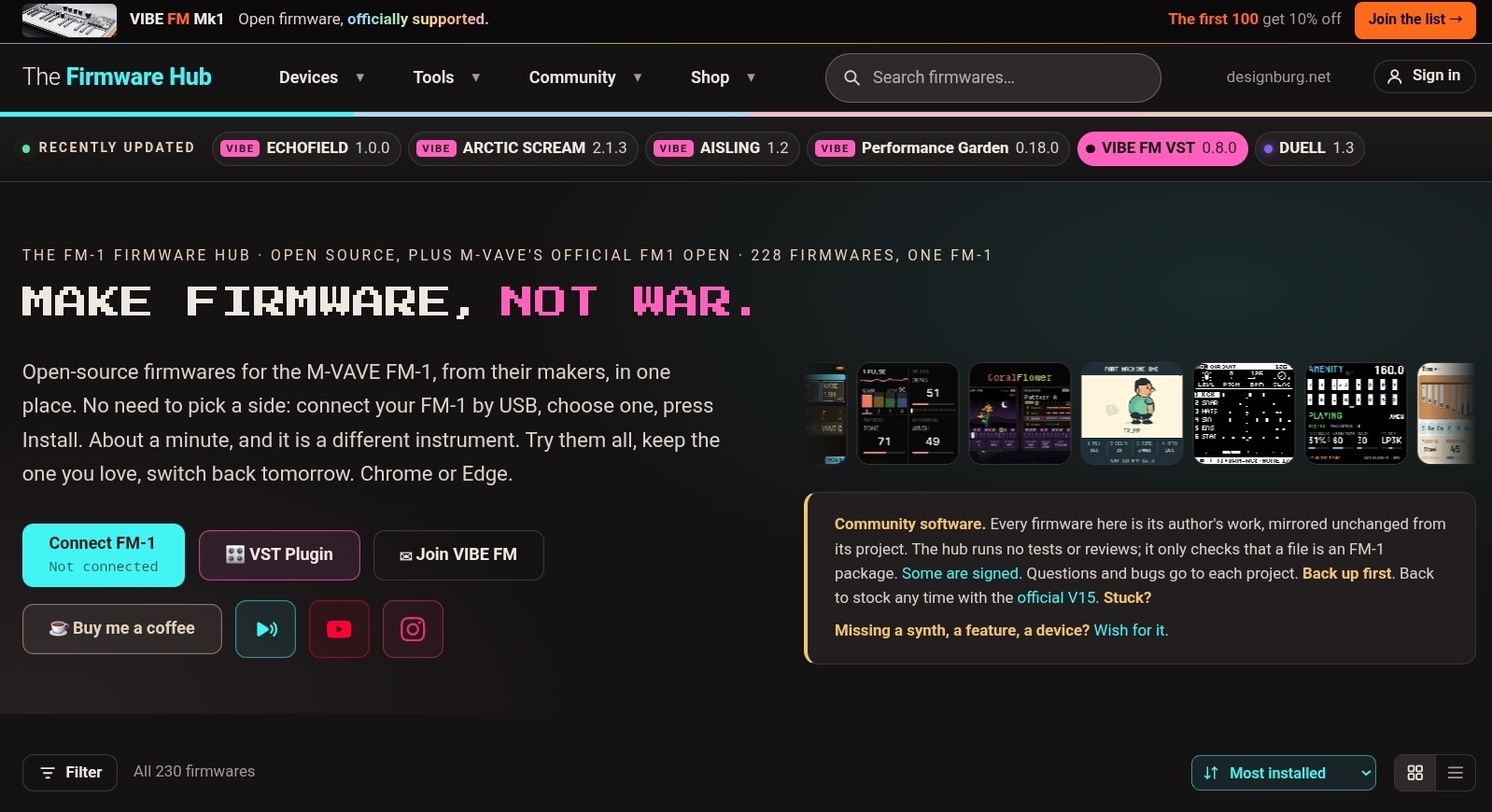
I’m not in the camp of all vibe-coded software being bad, and I’ve thrown together some utilities using AI both for me and my readers. All the music firmware I’ve seen is free and of pure intention–people genuinely just want to get more out of their music gear and share with others–so it falls into a camp that I’m mostly okay with. The FM-1’s stock firmware is atrocious and alternative I’m using (Sloop) is a ton of fun.
The big risk is that it can break your gear, as with some firmwares that turned some newer FM-1 variants into paperweights, though the speed of development is such that fixes arrive just as quickly.
Mostly, though, this just serves as an example of the uncharted territory we’re entering, where anyone with enough Claude credits can cobble together passable versions of pretty much anything, for better or worse. (See also: What’s happening with video game recomps and ports, as excellently described by Wes Fenlon.) The ramifications will be far-reaching, and I’m still working through how to feel about all of it.