
Less neutrality, more synergy, and a couple of dead products.
 Jared Newman |
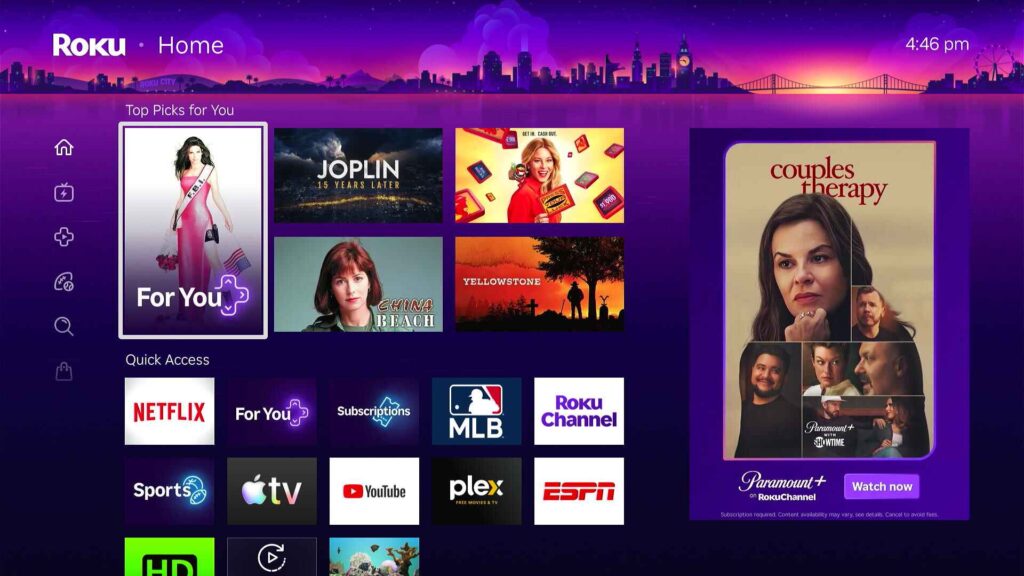
Fox and Roku left a lot of questions unanswered when they announced their merger plans back in June. Now that Fox has completed the acquisition, it’s time to start filling in the blanks.
While Roku users shouldn’t expect sweeping changes, the platform will likely become a bit more biased towards Fox streaming services. Some of the companies’ streaming services may also undergo changes as they move under one roof, and at least a couple of Roku offerings are disappearing entirely.
If you have a Roku TV or streaming player, here’s what to expect under Fox’s ownership:
More Fox promo
To get approval from the Justice Department, Roku agreed to four conditions, two of which are directly consumer-related:
- Roku devices will continue to carry non-Fox content for at least three years.
- Fox will “not discriminate against non-Fox content” in search results, and will allow users to rearrange apps on their home screens.
- Roku will keep Fox from accessing competitors’ sensitive data—things like what people click on and watch in rival streaming apps—for at least three years.
- Roku will continue to offer data products to third parties.
The first commitment is the most amusing, because it’s pointless. Roku was never going to stop carrying content from other companies, because that’s where most of its money comes from and it’s why people seek out Roku TVs and streaming players to begin with.
The real impact will be subtler, as you can expect Roku to pre-install more Fox apps and recommend more Fox content on the home screen. Roku founder Anthony Wood, who will now co-chair Fox’s digital platforms, said in a June investor call that Roku will “obviously include Fox properties” in the spaces where it promotes its own content. The second commitment doesn’t change any of that. It merely ensures that users will retain some level of home screen customization, and that search results won’t be weighed entirely in Fox’s favor.
And while the Justice Department believes that Roku “will remain an open and neutral content partner post-merger,” it extracted no specific concessions on that front. Besides, Roku hasn’t been a neutral party for years, and it has a history of sacrificing openness in pursuit of its business goals. Don’t expect that to change under Fox.
Tubi and the Roku Channel remain separate (for now)
Fox CEO Lachlan Murdoch said in June that he expected Roku’s and Fox’s respective ad-supported streaming services to remain separate. Now, Fox seems to be making good on that plan by placing Tubi and the Roku Channel under different management. As noted in a company memo, Tubi will become part of Fox’s Direct-To-Consumer business led by CEO Pete Distad, while the Roku Channel will remain under Roku’s purview, led by CEO Mustafa Ozgen.
I doubt the two services will stay apart forever, as there’s just too much upside in scaling a single ad-supported service, but a merger probably won’t happen anytime soon if they’re operating under separate hierarchies.
Tubi, Fox One, and Frndly TV could be intertwined, though
Frndly TV is a low-cost, rerun-centric, sports-free bundle of pay TV channels, which Roku acquired last year. Post-acquisition, Fox will manage Frndly through its direct-to-consumer business alongside Tubi and Fox One, even as the Roku Channel and Howdy stay under Roku management.
Fox is already hinting at some cross-pollination: “Bringing free and subscription services together creates opportunities to better serve viewers, connect audiences, and build smarter bundles,” the company said in a memo to employees. Does this mean Fox will bring more of its properties into Frndly, or possibly bundle up Frndly with Fox One? It’s too early to say, but under Fox management, Frndly is too niche a service to stay the way it is forever.
The smart home push is dead
Roku started selling security cameras and other smart home products in 2022. Now, Janko Roettgers reports that Roku is getting out of that business. It’ll continue to support existing devices, but won’t develop new ones, and existing products are nearly sold out.
This isn’t a huge surprise. The smart home endeavor was always half-hearted, relying on a Wyze partnership that was barely a step beyond white-labeling. Fox’s acquisition announcement didn’t mention the smart home products at all, and in September, Roku open-sourced the underlying operating system, foreshadowing its plan to walk away.
Still, those who invested in Roku’s smart home vision are getting a raw deal. Even with ongoing support, they won’t be able to replace failing products or expand their systems over time.
Aquatic Life is dying
The most immediately tangible effect of Fox acquiring Roku will happen on December 1, when Roku’s Aquatic Life screensaver will stop working. As Cord Cutters News reported last week, Roku licensed the screensaver from a company called SereneScreen, whose developer decided to end the arrangement in protest of the Fox acquisition. Roku users who’ve set Aquatic Life as their screensaver will automatically switch over to the default Roku City after this month.
In a way, it’s symbolic. Aquatic Life was the best Roku screensaver, remaining a calm, non-commercial space even as Roku’s home screen became bloated with banner ads and upsells. Roku City had similarly-innocent origins as a fun tribute to movie history, but over time it became a glorified billboard for brands and media companies. As Fox seeks to recoup the $22 billion it sunk into Roku, it’ll need to turn on every monetization spigot it can. Shutting off the aquarium may be a happy accident.
Sign up for Jared’s Cord Cutter Weekly newsletter for more streaming TV advice.